3 September 2026
What Streaked Cladding Is Telling Your Customers (And Why Scaffolding Isn't the Only Option)
Cladding is the first thing anyone sees before they reach your door — a customer walking up to a shopfront, a tenant touring an office, a client pulling into an industrial site. Algae streaking, traffic grime, and pollution staining on that cladding reads as neglect before anyone’s even inside, whatever the actual standard of the business behind it.
Why commercial cladding streaks the way it does
Render, composite panel, timber, and metal cladding all pick up dirt differently, but the streaking pattern is usually the same story: rainwater runs down the building carrying airborne pollution and algae spores with it, and wherever that water travels slowest — under window ledges, along panel joints, down north-facing elevations that rarely dry — is where the staining shows up darkest first. Buildings near busy roads pick up traffic grime on top of that, and older or lower-grade cladding materials are more porous, so the staining works into the surface rather than sitting on top of it.
Why scaffolding has been the default — and why it doesn’t have to be
Upper floors are the obvious sticking point for any commercial cladding job. Scaffolding or a cherry picker get the access sorted, but both are expensive to book, take time to erect, and mean weeks of a wrapped or fenced-off building — exactly the kind of disruption a working office, retail unit, or industrial site can’t easily absorb.
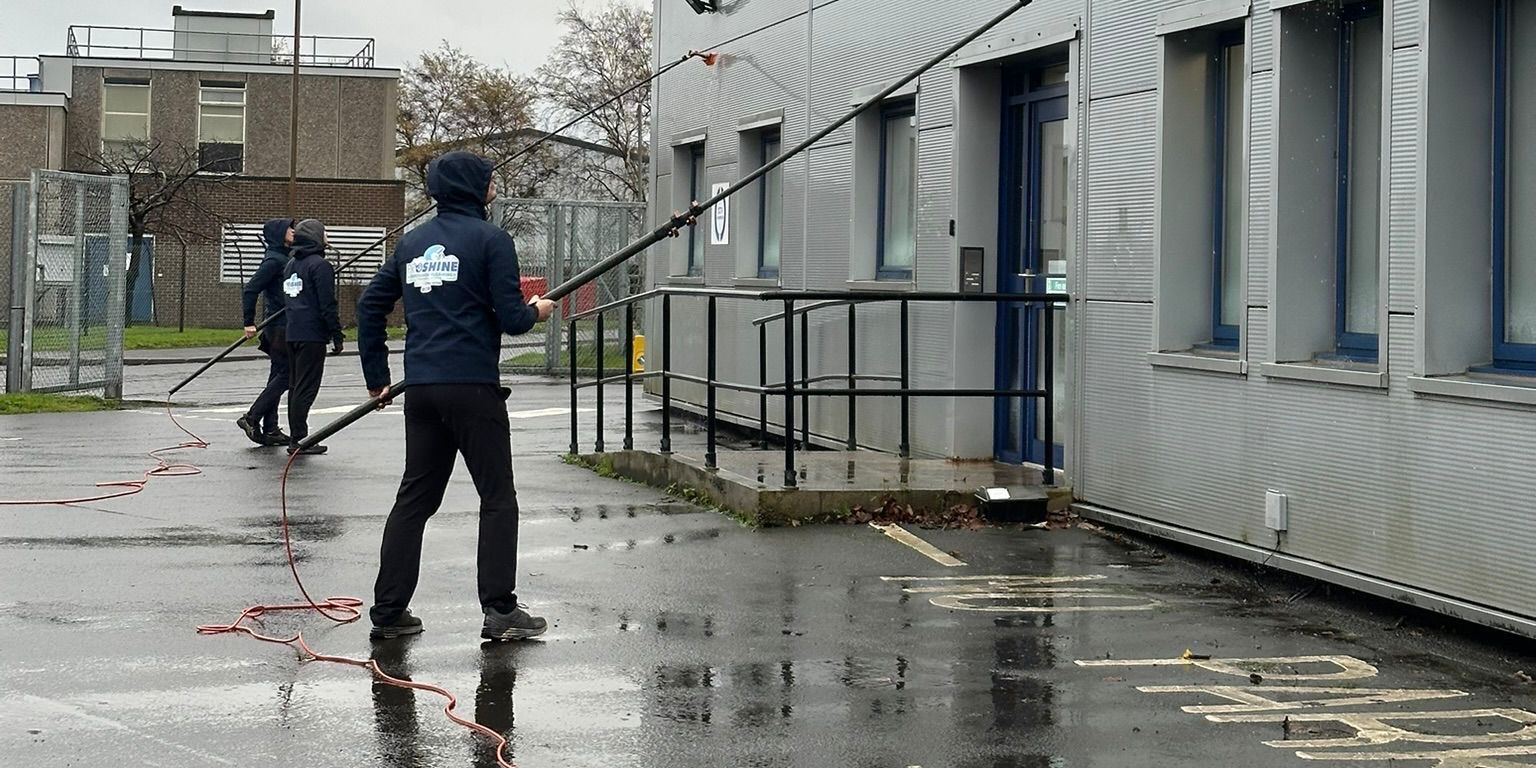
A water-fed pole system reaches most upper floors safely from ground level instead, which is how most buildings get cleaned without scaffolding or lift hire at all. It keeps both the cost and the disruption down, and there’s no wrapped scaffolding sitting in front of your building signalling “something’s wrong here” for weeks at a time — arguably worse for first impressions than the staining it’s there to fix.
Matched to the material, not a single generic wash
Render, composite panel, timber, and metal all need different pressure and chemistry to clean properly without damage — the same underlying principle we apply to sandstone versus modern render elsewhere: match the method to the material, don’t use one setting for everything. We check the cladding type and the building’s aspect before recommending anything, and you get honest advice on realistic cleaning frequency, rather than a one-size-fits-all schedule.
Built around how commercial sites actually operate
Every commercial job gets a site-specific Risk Assessment and Method Statement, and we can work out-of-hours where that avoids disrupting staff, tenants, or customers — relevant whether it’s an office or retail unit, a site managed by a property factor, or an industrial or facilities building where access and site rules matter as much as the clean itself.
Get your building’s first impression back
Reach-and-wash cladding cleaning matched to your material, usually without scaffolding, and RAMS documentation ready before we’re on site. Request your free commercial cladding cleaning quote.
Need this done?
Get a free cladding cleaning quote
Reach-and-wash cladding cleaning for commercial buildings, no scaffolding needed.
View Cladding Cleaning