Solar panels are sold on years of maintenance-free performance, and for the most part that’s true — but “maintenance-free” doesn’t mean “immune to grime.” A layer of dust, pollen, or bird droppings sitting across a panel blocks sunlight from ever reaching the cells underneath, and it builds up slowly enough that most owners never notice until they check their generation figures against last year’s.
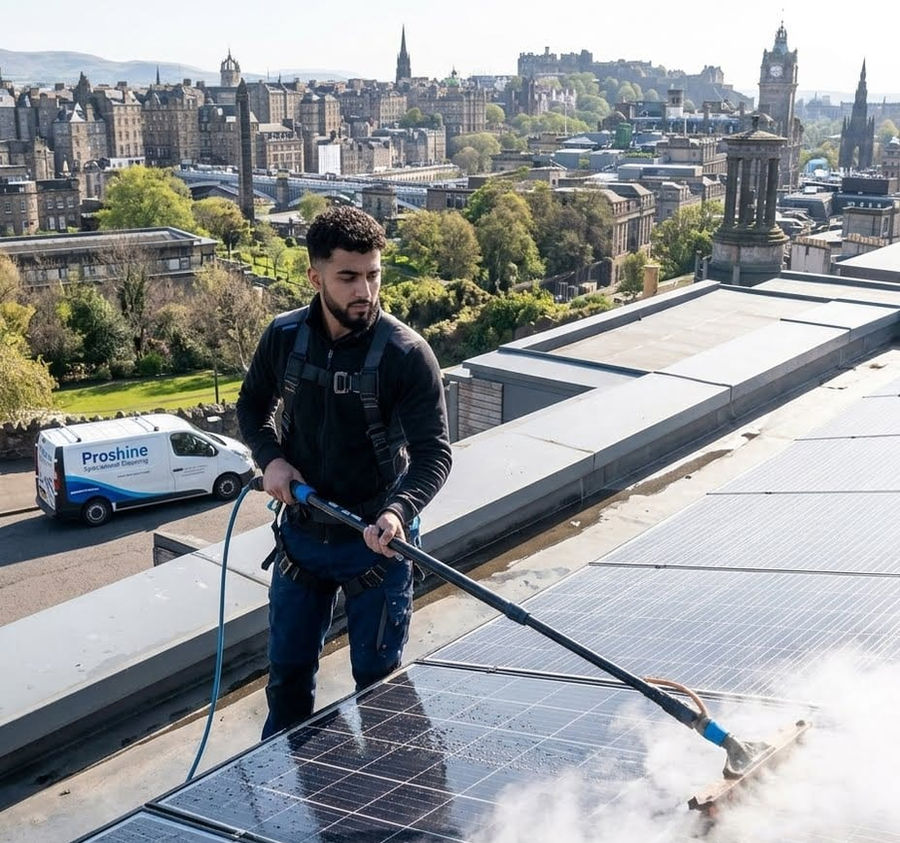
Want your panels cleaned? We clean solar panels for homes and businesses across Edinburgh with our Hydro Heat system: heated, ultra-purified water on a water-fed pole and a soft, non-abrasive brush, without walking on the panels. See our solar panel cleaning service and get a free quote →
Why do solar panels get dirty in the first place?
Panels are mounted flat or at a shallow angle facing the sky, which makes them a natural landing spot for everything airborne — pollen in spring, dust and traffic grime year-round, and bird droppings wherever there’s overhanging trees or perching spots nearby. Rain washes some of it off, but Edinburgh’s rainfall is rarely heavy or direct enough to fully clean a shallow-angled panel the way it would a vertical window. What’s left behind builds up in a thin film that’s easy to miss from the ground.
Does dirt actually reduce solar panel output?
Yes — even a light, even layer of grime reduces the light reaching the cells, and output drops accordingly. The effect is worse with patchy build-up, like a scatter of bird droppings or leaf debris, because those small opaque spots can disproportionately affect an entire string of cells rather than just the shaded area itself. The exact percentage varies with how dirty the panels get and how long they’ve gone since the last clean, but the direction is always the same: less light in, less output out.
Why we don’t just pressure wash panels
Panels are a sealed, warrantied piece of equipment, and standard pressure washing is exactly the kind of thing that can void that warranty — forced water can get past seals, and the pressure itself risks micro-scratches on the glass surface that scatter light and reduce output further, which defeats the purpose of cleaning them at all.
Instead we use our Hydro Heat pure water fed-pole system: heated, ultra-purified water free of minerals, applied with a soft, non-abrasive brush and finished with a pure-water rinse. Because the water has no mineral content, panels dry naturally without streaks or the water spots that ordinary tap water leaves behind — and because there’s no pressure involved, there’s no risk to seals or the panel surface. Most panels are cleaned from the roof edge or with extended-reach equipment, without anyone walking on the panels themselves.
How often should solar panels be cleaned?
It depends on what’s around the installation. Panels under or near trees need attention more often because of pollen and leaf debris; anywhere with regular bird activity is the same story. As a general guide, once or twice a year covers most residential installations, with pollen season in spring and leaf fall in autumn being the two points worth checking regardless of your usual schedule.
Is it worth it?
For most households, yes — a clean typically costs far less than a single quarter’s worth of the output it recovers, and the panels keep performing at their rated level for the rest of the system’s lifespan rather than quietly under-delivering. It’s a small, occasional job that protects a much larger investment.
Get your panels checked
We check panel type, roof pitch, and access before starting, and you’ll get a cleaning-frequency recommendation based on how exposed your roof is to pollen, dust, and bird activity. Request your free, no-obligation solar panel cleaning quote.
Need this done?
Get a free solar panel cleaning quote
If your solar panels aren't getting the shine because of all that grime, call Proshine.
View Solar Panel Cleaning