13 August 2026
Why Your Windows Still Look Streaky After Cleaning (And What Actually Fixes It)
You’ve had the windows cleaned, and for a day or two they look great. Then the sun comes out at a low angle and there they are again — faint streaks and spotting across the glass, like it was never cleaned at all. That’s not a sign of a rushed job. It’s almost always the water.
The problem isn’t the squeegee — it’s what’s in the water
Ordinary tap water carries dissolved minerals — calcium, magnesium, the things that cause limescale in a kettle. Traditional window cleaning uses tap water with a bit of detergent, wiped off with a squeegee. The glass looks clean while it’s wet, but as the water evaporates, those minerals don’t evaporate with it. They’re left behind as a thin, dry film that shows up as streaking and spotting the moment light hits the glass at the wrong angle. The harder the local water, the worse it gets — and it comes back after every rinse, no matter how careful the squeegee technique is.
What pure water actually changes
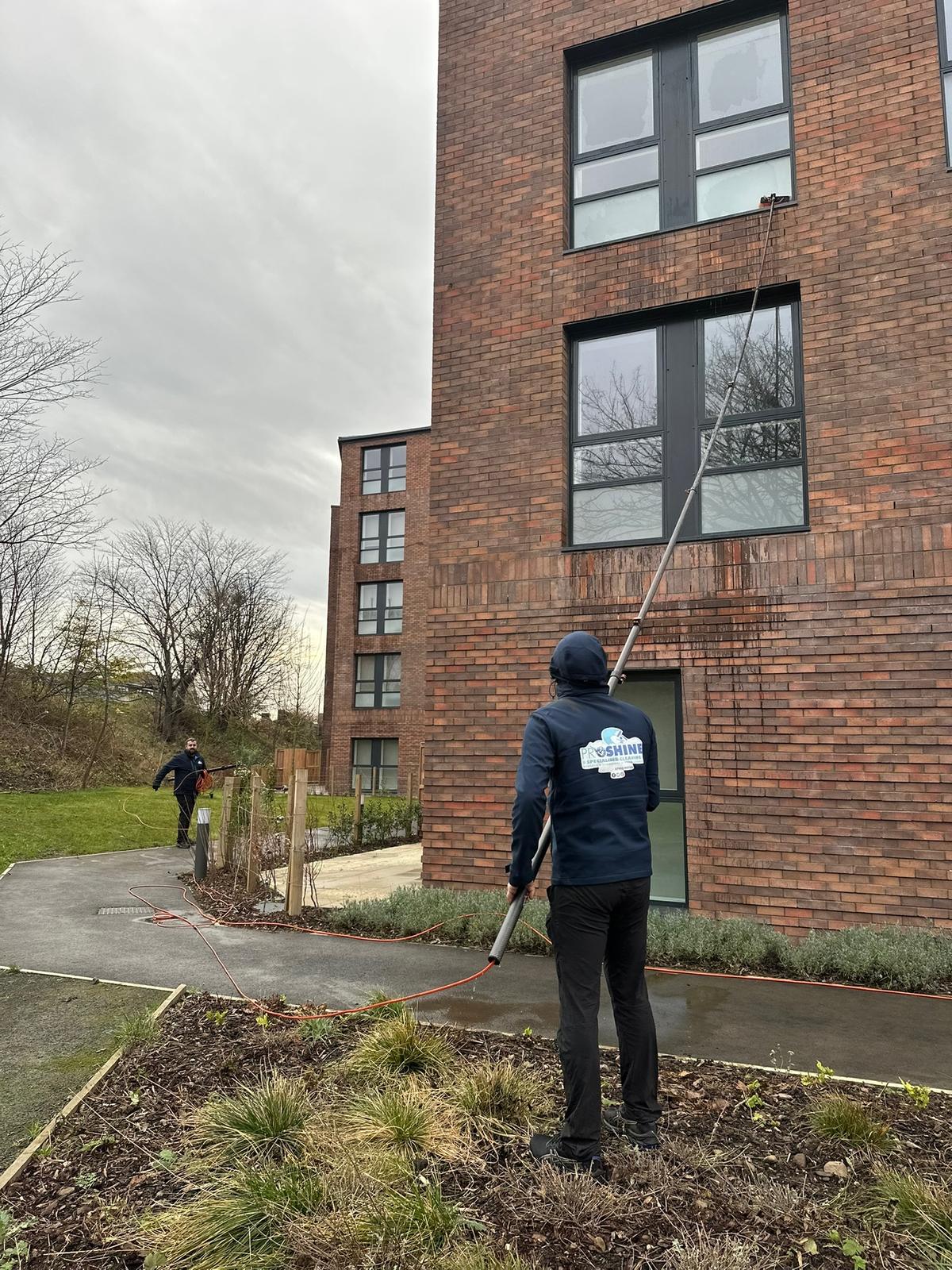
Proshine uses Hydro Heat Technology — heated, ultra-purified water fed through carbon-fibre poles, with the minerals filtered out before it ever touches the glass. Because there’s nothing left in the water to dry into a film, the glass dries completely naturally, with no streaks or spotting to wipe away in the first place. It’s not a better wiping technique; it’s removing the thing that causes the problem at all.
Heating the water matters too, particularly in an Edinburgh winter — warm water lifts grime and breaks down grease faster than cold, and dries more evenly on cold glass instead of leaving the water time to sit and re-deposit minerals as it cools.
Reaching upper floors without a ladder against your property
Water-fed poles solve a second problem that’s specific to Edinburgh’s housing stock: access. A huge share of the city’s windows are on upper floors of tenements, colony flats, and villas, and traditional cleaning meant either a ladder resting against sash windows and sandstone reveals, or skipping the upper floors altogether. Carbon-fibre poles reach those windows safely from ground level, with no ladder contact and no risk to sash cords or period glazing.
This matters more than it sounds for older Edinburgh properties. A ladder braced against a sandstone sill or a fragile sash frame is exactly the kind of contact that can chip stonework or strain glazing bars that have been in place for a century — the same reason we use steam rather than force on sandstone elsewhere on the building. Keeping the cleaning equipment off the property itself avoids the risk entirely.
Tenement stairs and shared access
Marchmont and Bruntsfield tenement stairs, Stockbridge and Abbeyhill colony flats, shared back-green access — these are the norm in Edinburgh, not the exception, and they come with their own access logistics: stair door codes, shared garden entry, resident parking restrictions. We plan the visit around those details when you enquire, rather than turning up and hoping.
How often do Edinburgh windows actually need cleaning?
It depends more on aspect and traffic than a fixed calendar date. A ground-floor shopfront on a busy road re-soils far faster than a top-floor flat facing a quiet back green. We’ll recommend a realistic frequency based on your property’s exposure rather than a generic six-week schedule that doesn’t match how quickly your specific windows actually get dirty.
Get a genuinely spot-free clean
No mineral streaks, no ladders against your sandstone, and a frequency recommendation based on your actual property. Request your free window cleaning quote and see the difference pure water makes.
Need this done?
Get a free window cleaning quote
Clean windows tell the right story to your customers. We can make sure they gleam.
View Window Cleaning